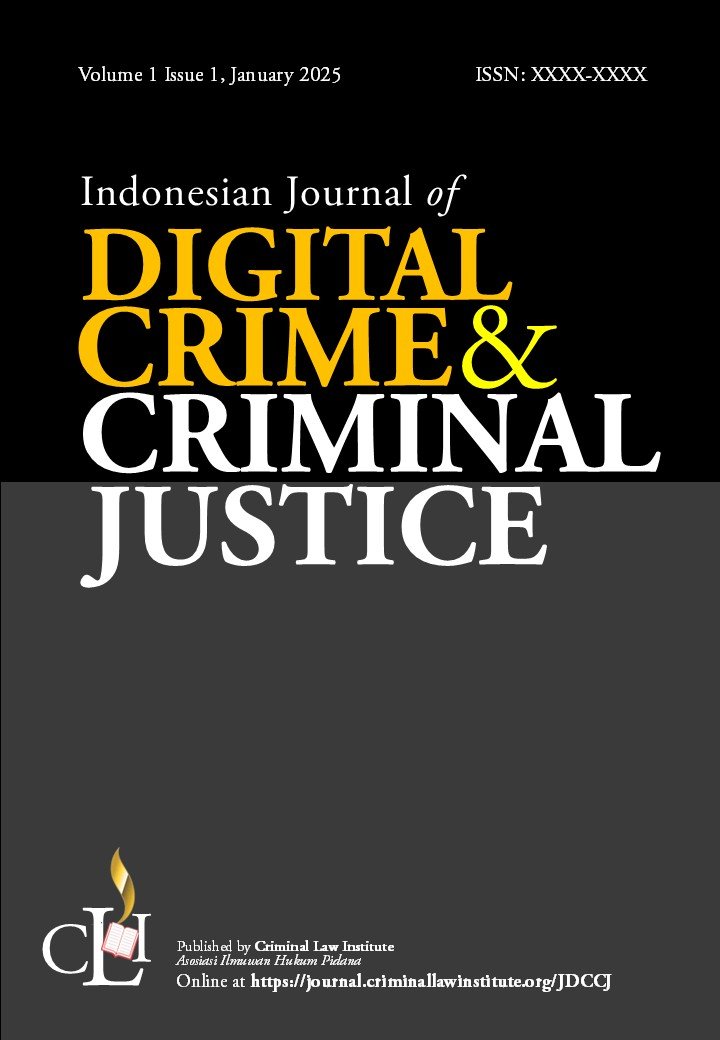
Algorithmic Policing and Due Process Rights: Balancing Efficiency and Fairness in Criminal Justice in Indonesia
DOI:
https://doi.org/10.68080/jdccj.v1i1.18Keywords:
Algorithmic Policing, Due Process, Criminal Justice Indonesia, Artificial Intelligence, Fair Trial, Digital GovernanceAbstract
The integration of algorithmic systems in policing has transformed criminal justice administration by enhancing predictive capabilities and operational efficiency. However, the deployment of algorithmic policing raises critical concerns regarding due process rights, transparency, and potential bias. This article examines the implications of algorithm-driven law enforcement practices in Indonesia, focusing on the tension between technological efficiency and fundamental legal safeguards. Using normative legal research combined with comparative insights from jurisdictions such as the United States and the European Union, the study evaluates whether existing Indonesian legal frameworks adequately regulate algorithmic decision-making in policing. The findings indicate that while algorithmic tools may improve crime detection and resource allocation, they also risk reinforcing structural biases embedded in training data, leading to discriminatory outcomes. Furthermore, the lack of transparency and explainability in algorithmic systems undermines the principles of fair trial and accountability. The article argues that Indonesia’s criminal justice system requires regulatory intervention to ensure algorithmic accountability, including mandatory impact assessments, transparency obligations, and judicial oversight mechanisms. It concludes that balancing efficiency and fairness necessitates a rights-based regulatory approach to algorithmic policing.
References
Angwin, Julia, Jeff Larson, Surya Mattu, and Lauren Kirchner. 2016. “Machine Bias.” ProPublica.
Ashworth, Andrew, and Mike Redmayne. 2010. The Criminal Process. 4th ed. Oxford: Oxford University Press.
Asshiddiqie, Jimly. 2006. Pengantar Ilmu Hukum Tata Negara. Jakarta: Sekretariat Jenderal MK RI.
Barocas, Solon, and Andrew D. Selbst. 2016. “Big Data’s Disparate Impact.” California Law Review 104 (3): 671–732.
Benjamin, Ruha. 2019. Race After Technology. Cambridge: Polity Press.
Berk, Richard. 2017. Artificial Intelligence, Predictive Policing, and Risk Assessment for Law Enforcement. New York: Springer.
Braga, Anthony A., Andrew V. Papachristos, and David M. Hureau. 2019. “The Effects of Hot Spots Policing on Crime.” Annals of the American Academy of Political and Social Science 578 (1): 104–125.
Brayne, Sarah. 2021. Predict and Surveil: Data, Discretion, and the Future of Policing. New York: Oxford University Press.
Brenner, Susan W. 2010. Cybercrime: Criminal Threats from Cyberspace. Santa Barbara: Praeger.
Citron, Danielle Keats, and Frank Pasquale. 2014. “The Scored Society: Due Process for Automated Predictions.” Washington Law Review 89 (1): 1–33.
Crawford, Kate. 2021. Atlas of AI: Power, Politics, and the Planetary Costs of Artificial Intelligence. New Haven: Yale University Press.
Dicey, A. V. 1982. Introduction to the Study of the Law of the Constitution. Indianapolis: Liberty Fund.
Ensign, Danielle, et al. 2018. “Runaway Feedback Loops in Predictive Policing.” Conference on Fairness, Accountability, and Transparency (FAT*) Proceedings.
Eubanks, Virginia. 2018. Automating Inequality: How High-Tech Tools Profile, Police, and Punish the Poor. New York: St. Martin’s Press.
Ferguson, Andrew Guthrie. 2017. The Rise of Big Data Policing: Surveillance, Race, and the Future of Law Enforcement. New York: New York University Press.
Garvie, Clare, Alvaro Bedoya, and Jonathan Frankle. 2016. The Perpetual Line-Up: Unregulated Police Face Recognition in America. Washington, DC: Georgetown Law Center on Privacy & Technology.
Government of Canada. 2020. Directive on Automated Decision-Making.
Lum, Kristian, and William Isaac. 2016. “To Predict and Serve?” Significance 13 (5): 14–19.
Lyon, David. 2018. The Culture of Surveillance. Cambridge: Polity Press.
Matthias, Andreas. 2004. “The Responsibility Gap.” Ethics and Information Technology 6 (3): 175–183.
McGregor, Lorna, Daragh Murray, and Vivian Ng. 2019. “International Human Rights Law as a Framework for Algorithmic Accountability.” International and Comparative Law Quarterly 68 (2): 309–343.
Mittelstadt, Brent D., Patrick Allo, Mariarosaria Taddeo, Sandra Wachter, and Luciano Floridi. 2016. “The Ethics of Algorithms: Mapping the Debate.” Big Data & Society 3 (2): 1–21.
Morozov, Evgeny. 2013. To Save Everything, Click Here. New York: PublicAffairs.
O’Neil, Cathy. 2016. Weapons of Math Destruction. New York: Crown.
Pasquale, Frank. 2015. The Black Box Society. Cambridge: Harvard University Press.
Perry, Walter L., Brian McInnis, Carter C. Price, Susan Smith, and John S. Hollywood. 2013. Predictive Policing: The Role of Crime Forecasting in Law Enforcement Operations. Santa Monica, CA: RAND Corporation.
Ratcliffe, Jerry H. 2016. Intelligence-Led Policing. 2nd ed. London: Routledge.
Republic of Indonesia. Law No. 11 of 2008 concerning Electronic Information and Transactions (as amended).
Republic of Indonesia. Law No. 2 of 2002 concerning the Indonesian National Police.
Republic of Indonesia. Law No. 27 of 2022 concerning Personal Data Protection.
Richards, Neil M., and Jonathan H. King. 2014. “Big Data Ethics.” Wake Forest Law Review 49 (2): 393–432.
Russell, Stuart, and Peter Norvig. 2021. Artificial Intelligence: A Modern Approach. 4th ed. Harlow: Pearson.
Selbst, Andrew D. 2017. “Disparate Impact in Big Data Policing.” Georgia Law Review 52 (1): 109–195.
Tyler, Tom R. 2006. Why People Obey the Law. Princeton: Princeton University Press.
Veale, Michael, and Frederik Zuiderveen Borgesius. 2021. “Demystifying the Draft EU Artificial Intelligence Act.” Computer Law Review International 22 (4): 97–112.
Wachter, Sandra, Brent Mittelstadt, and Luciano Floridi. 2017. “Why a Right to Explanation of Automated Decision-Making Does Not Exist in the GDPR.” International Data Privacy Law 7 (2): 76–99.
Yeung, Karen. 2018. “Algorithmic Regulation: A Critical Interrogation.” Regulation & Governance 12 (4): 505–523.
Završnik, Aleš. 2021. “Criminal Justice, Artificial Intelligence Systems, and Human Rights.” ERA Forum 20 (4): 567–583.
Zuboff, Shoshana. 2019. The Age of Surveillance Capitalism: The Fight for a Human Future at the New Frontier of Power. New York: PublicAffairs.
Downloads
Published
Issue
Section
License
Copyright (c) 2025 Hans Ari Saputra (Author)

This work is licensed under a Creative Commons Attribution 4.0 International License.