Publication Ethics
The Indonesian Journal of Digital Crime and Criminal Justice is committed to maintaining the highest standards of publication ethics, academic integrity, and transparency in scholarly publishing. The journal adheres to the principles and best practices established by the Committee on Publication Ethics (COPE), the Directory of Open Access Journals (DOAJ)> Principles of Transparency and Best Practice in Scholarly Publishing, and internationally accepted standards of responsible research and publication.
All parties involved in the publication process—including authors, editors, reviewers, and the publisher—are expected to comply with the ethical standards outlined in this statement. The journal takes all reasonable measures to identify and prevent publication malpractice and is committed to investigating allegations of misconduct fairly and transparently.
Ethical Responsibilities of Authors
Originality and Plagiarism
Authors must ensure that submitted manuscripts are original works and have not been plagiarized, in whole or in part. All sources and references used in the manuscript must be properly acknowledged and cited.
Multiple, Redundant, or Concurrent Publication
Authors must not submit the same manuscript to more than one journal simultaneously. Manuscripts that have been published previously or are under consideration elsewhere will not be accepted.
Authorship and Contributorship
Authorship should be limited to individuals who have made substantial scholarly contributions to the research and manuscript preparation. All authors must approve the final version of the manuscript and agree to its submission.
Data Integrity and Research Accuracy
Authors must present accurate data and findings. Fabrication, falsification, selective reporting, or manipulation of data constitutes serious ethical misconduct.
Disclosure of Conflicts of Interest
Authors must disclose any financial, institutional, professional, or personal relationships that may influence the interpretation of their research.
Acknowledgement of Sources
Authors are required to provide proper acknowledgment of all works, data, and ideas that have influenced their research.
Fundamental Errors in Published Works
When authors discover significant errors in a published article, they must promptly notify the editors and cooperate in correcting or retracting the publication as appropriate.
Ethical Responsibilities of Reviewers
Confidentiality
All manuscripts received for review must be treated as confidential documents. Reviewers must not share, discuss, or use unpublished information for personal advantage.
Objectivity and Fairness
Reviews should be conducted objectively and constructively. Personal criticism of authors is inappropriate. Reviewers should provide clear, evidence-based recommendations.
Acknowledgment of Relevant Literature
Reviewers should identify relevant published works not cited by the authors and alert editors to any substantial similarity or overlap with other publications.
Conflict of Interest
Reviewers must disclose any conflicts of interest and decline review assignments where such conflicts may affect their impartiality.
Timeliness
Reviewers should complete reviews within the agreed timeframe or notify the editor if they are unable to do so.
Ethical Responsibilities of Editors
Editorial Independence
Editors make publication decisions solely on the basis of academic merit, originality, significance, methodological rigor, and relevance to the journal’s scope.
Fair Play and Non-Discrimination
Editors evaluate manuscripts without regard to race, gender, nationality, ethnicity, religion, political beliefs, institutional affiliation, or other personal characteristics of the authors.
Confidentiality
Editors and editorial staff must maintain the confidentiality of submitted manuscripts and information related to the review process.
Conflict of Interest
Editors must not use unpublished information from submitted manuscripts for personal research or gain. Manuscripts involving conflicts of interest must be handled by another editor.
Handling Allegations of Misconduct
Editors will follow established ethical procedures and, where appropriate, the guidance provided by COPE in addressing allegations of plagiarism, duplicate publication, data manipulation, authorship disputes, peer-review manipulation, and other forms of misconduct.
Ethical Responsibilities of the Publisher
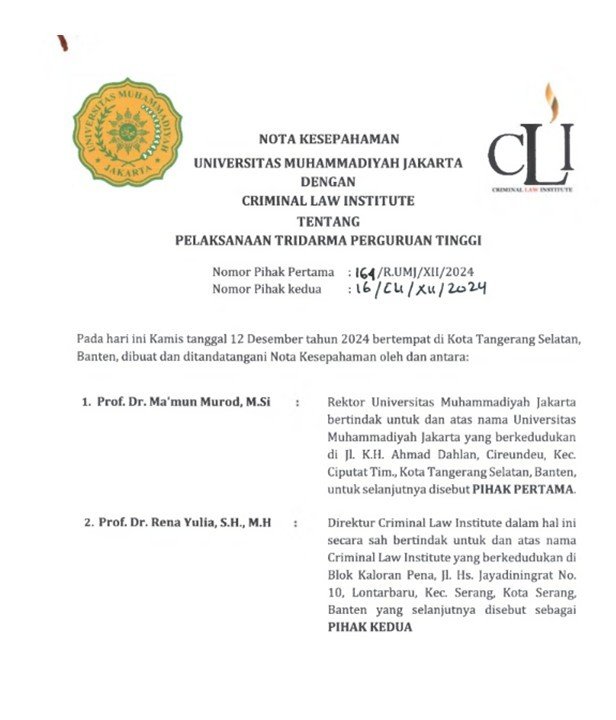
The publisher, Asosiasi Ilmuan Hukum Pidana (Criminal Law Institute) Indonesia, supports the Editorial Board in maintaining editorial independence, publication integrity, and adherence to recognized ethical standards.
The publisher is committed to:
- Upholding academic freedom and editorial independence;
- Supporting transparent and ethical publishing practices;
- Preventing publication misconduct;
- Facilitating corrections, retractions, and clarifications when necessary;
- Preserving the integrity and accessibility of the scholarly record.
Publication Malpractice
The journal strictly prohibits all forms of publication misconduct, including but not limited to:
- Plagiarism;
- Self-plagiarism and redundant publication;
- Data fabrication or falsification;
- Citation manipulation;
- Ghost authorship, guest authorship, or gift authorship;
- Undisclosed conflicts of interest;
- Peer-review manipulation;
- Ethical violations in research and publication practices.
Any allegation of misconduct will be investigated by the Editorial Board in accordance with established ethical procedures and COPE recommendations. Appropriate actions may include manuscript rejection, publication of corrections, retraction of articles, notification to affiliated institutions, or other corrective measures.
Corrections, Retractions, and Expressions of Concern
The journal is committed to maintaining the integrity of the scholarly record. When necessary, the journal may publish:
- Corrections (Errata/Corrigenda) for minor errors that do not invalidate the findings;
- Retractions for articles containing serious errors, misconduct, plagiarism, or unreliable findings;
- Expressions of Concern when investigations are ongoing or evidence is inconclusive.
Such actions will be conducted in accordance with COPE Retraction Guidelines and international best practices in scholarly publishing.
Screening for Plagiarism
All submitted manuscripts are screened using plagiarism detection software prior to peer review. Manuscripts containing significant plagiarism, duplicate publication, or other forms of unethical overlap will be rejected. The journal generally applies a maximum similarity threshold determined by the Editorial Board, excluding references, quotations, and standard methodological descriptions.
Commitment to Ethical Publishing
By submitting, reviewing, editing, or publishing with the Indonesian Journal of Digital Crime and Criminal Justice, all parties agree to uphold the principles of honesty, transparency, accountability, fairness, and academic integrity.
The journal follows the ethical principles and best practices promoted by:
- Committee on Publication Ethics (COPE)
- Directory of Open Access Journals (DOAJ)
- Open Access Scholarly Publishing Association (OASPA)
- World Association of Medical Editors (WAME) (regarding editorial independence and publication ethics principles)
Through adherence to these standards, the Indonesian Journal of Digital Crime and Criminal Justice seeks to ensure the publication of high-quality, ethical, and impactful scholarship in the fields of criminal law, criminal justice, digital crime, and emerging technologies.