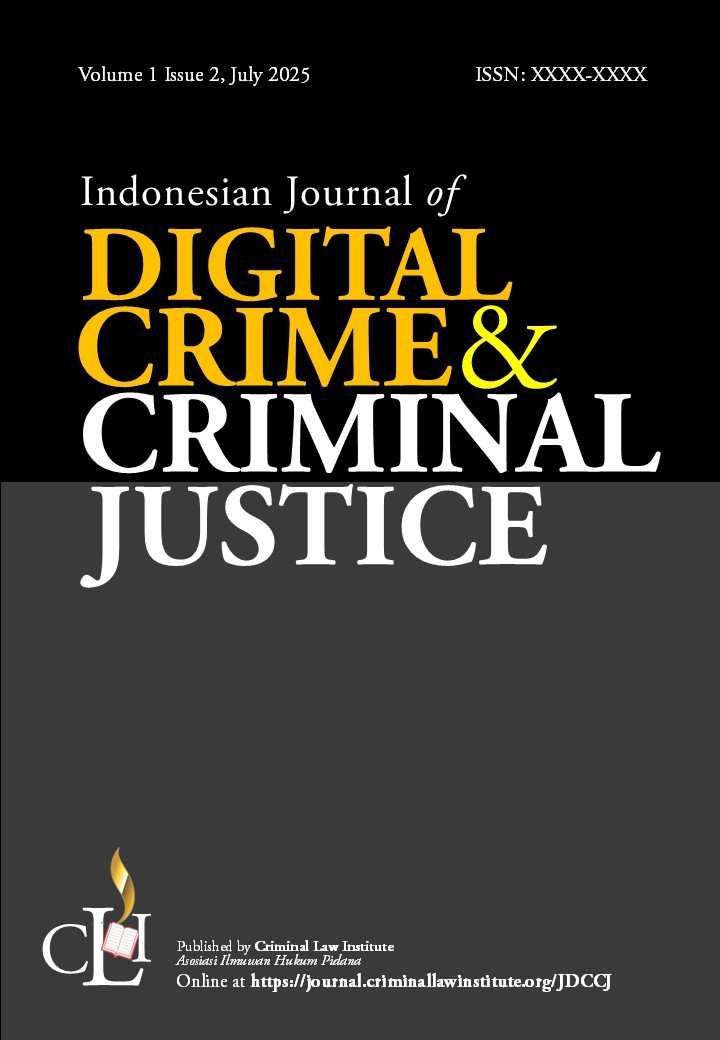
The Role of International Law in Addressing State-Sponsored Cyber Operations
DOI:
https://doi.org/10.68080/jdccj.v1i2.30Keywords:
International Law, Cyber Operations, State Responsibility, Cybersecurity, Indonesia, Digital Conflict, International Legal OrderAbstract
State-sponsored cyber operations have emerged as a significant threat to international peace, security, and sovereignty in the digital era. These operations, which may include cyber espionage, infrastructure disruption, and information warfare, challenge traditional frameworks of international law. This article examines the role of international law in regulating and responding to state-sponsored cyber operations, with a focus on implications for Indonesia as part of the global digital order. Using normative legal research and doctrinal analysis, the study evaluates existing principles of international law, including sovereignty, non-intervention, and the prohibition of the use of force, in the context of cyber operations. The findings suggest that current international legal frameworks are insufficiently specific to address the complexities of cyber conflicts, particularly regarding attribution and state responsibility. The article highlights ongoing debates on the applicability of international humanitarian law and state responsibility doctrines in cyberspace. It argues that Indonesia and other developing countries must actively engage in shaping emerging international norms to ensure equitable digital governance. The study concludes that strengthening international legal frameworks is essential to address accountability gaps in state-sponsored cyber activities.
References
Aji Putra, G. R. (2026). Tipologi kejahatan siber di Indonesia. Adalah: Buletin Hukum & Keadilan, 7(7), 1–15. https://doi.org/10.15408/adalah.v7i7.51838
ASEAN. (2021). ASEAN cybersecurity cooperation strategy. Association of Southeast Asian Nations. https://asean.org
Brownlie, I. (2008). Principles of public international law (7th ed.). Oxford University Press.
Buchanan, B. (2020). The hacker and the state: Cyber attacks and the new normal of geopolitics. Harvard University Press.
Crawford, J. (2013). State responsibility: The general part. Cambridge University Press.
De Hert, P., & Papakonstantinou, V. (2017). The EU cybersecurity framework. Computer Law & Security Review, 33(3), 373–389. https://doi.org/10.1016/j.clsr.2017.03.001
DeNardis, L. (2014). The global war for internet governance. Yale University Press.
Dinstein, Y. (2016). The conduct of hostilities under the law of international armed conflict (3rd ed.). Cambridge University Press.
Finnemore, M., & Hollis, D. (2016). Constructing norms for global cybersecurity. American Journal of International Law, 110(3), 425–479. https://doi.org/10.1017/S0002930000132040
Gani, N. (2023). Legal politics and data protection in Indonesia. SASI Journal, 29(2), 112–130. https://doi.org/10.47268/sasi.v29i2.2213
Gasser, H. P. (2015). Cyber warfare and international law. Harvard International Law Journal, 56(2), 1–20.
Gisel, L., Rodenhäuser, T., & Dörmann, K. (2020). Twenty years on: International humanitarian law and cyber operations. International Review of the Red Cross, 102(913), 1117–1138. https://doi.org/10.1017/S1816383120000387
Greenberg, A. (2018). Sandworm: A new era of cyberwar and the hunt for the Kremlin’s most dangerous hackers. Doubleday.
Hathaway, O. A., Crootof, R., Levitz, P., Nix, H., Nowlan, A., Perdue, W., & Spiegel, B. (2012). The law of cyber-attack. California Law Review, 100(4), 817–886. https://doi.org/10.15779/Z38CR5B
International Committee of the Red Cross (ICRC). (2019). International humanitarian law and cyber operations. https://www.icrc.org
International Court of Justice (ICJ). (1986). Military and Paramilitary Activities in and against Nicaragua (Nicaragua v. United States). https://www.icj-cij.org
Kello, L. (2017). The virtual weapon and international order. Yale University Press.
Klimburg, A. (2017). The darkening web: The war for cyberspace. Penguin Press.
Lin, H. (2016). Attribution of malicious cyber incidents. Journal of Cyber Policy, 1(1), 63–77. https://doi.org/10.1080/23738871.2016.1157681
Lokapala, Y. H., et al. (2023). Phishing trends in Indonesia. International Journal of Cyber Law and Cyber Crime, 3(2), 45–60. https://journal.umy.ac.id
Maurer, T. (2018). Cyber mercenaries: The state, hackers, and power. Cambridge University Press.
Nasyith, R. M., et al. (2026). Analysis of ransomware attacks on Bank Syariah Indonesia. Jurnal Ilmu Hukum dan Adat, 12(1), 55–72. https://ejournal.mandalanursa.org
Nye, J. S. (2017). Deterrence and dissuasion in cyberspace. International Security, 41(3), 44–71. https://doi.org/10.1162/ISEC_a_00266
Ohlin, J. D. (2013). Cyberwarfare and the law of armed conflict. American Journal of International Law Unbound, 107, 27–31. https://doi.org/10.1017/S0002930000036838
OSCE. (2016). Confidence-building measures to reduce the risks of conflict stemming from the use of ICTs. https://www.osce.org
Putra, G. R. A. (2026). Cybercrime typology in Indonesia. Adalah Journal. https://journal.uinjkt.ac.id
Rambe, R., & Hermawan, F. (2025). Ransomware attacks on Indonesian public systems: Legal and policy implications. Indonesian Journal of Cybersecurity, 4(1), 1–18. https://doi.org/10.1234/ijcs.v4i1.2025
Rid, T. (2020). Active measures: The secret history of disinformation and political warfare. Farrar, Straus and Giroux.
Roscini, M. (2014). Cyber operations and the use of force in international law. Oxford University Press.
Sassòli, M. (2016). International humanitarian law: Rules, controversies, and solutions to problems arising in warfare. Edward Elgar.
Schmitt, M. N. (2017). Tallinn manual 2.0 on the international law applicable to cyber operations. Cambridge University Press.
Schmitt, M. N., & Vihul, L. (2017). Sovereignty in cyberspace. American Journal of International Law Unbound, 111, 213–218. https://doi.org/10.1017/aju.2017.68
Shaw, M. N. (2021). International law (9th ed.). Cambridge University Press.
Tsagourias, N., & Buchan, R. (2015). Research handbook on international law and cyberspace. Edward Elgar.
UN Group of Governmental Experts (UN GGE). (2015). Report on developments in the field of information and telecommunications in the context of international security. United Nations. https://undocs.org
UN Open-Ended Working Group (OEWG). (2021). Final report. United Nations. https://undocs.org
Vasoya, S., et al. (2022). Ransomware attack trends: A global review. arXiv preprint. https://arxiv.org
Waluyadi. (2024). Enforcement challenges of the ITE Law in Indonesia. Indonesian Cyber Law Review, 2(1), 55–70. https://doi.org/10.5678/iclr.v2i1.2024
Waxman, M. (2011). Cyber-attacks and the use of force. International Law Studies, 87, 429–452.
World Bank. (2022). Indonesia digital economy report. https://worldbank.org
Zetter, K. (2014). Countdown to zero day: Stuxnet and the launch of the world’s first digital weapon. Crown Publishing.
Downloads
Published
Issue
Section
License
Copyright (c) 2025 Yasmin Cantika, Sergi Fernandez Alejandro, Valerio Sebastian, Christina Noelia Umbría, Izan Mateo Cassandro, Ridwan Arifin (Author)

This work is licensed under a Creative Commons Attribution 4.0 International License.