About the Journal
The Indonesian Journal of Digital Crime and Criminal Justice (Print ISSN: 3163-8368 / Online ISSN: 3164-0567) is a peer-reviewed scientific journal published by ILMUWAN HUKUM PIDANA (CRIMINAL LAW INSTITUTE). Established in 2025, the journal provides an academic platform for the publication of high-quality research on criminal law, criminal justice, digital crime, cyber law, cybersecurity, artificial intelligence and law, digital evidence, forensic technology, digital governance, and transnational criminal law. It welcomes original research articles, review articles, and conceptual papers from academics, researchers, practitioners, policymakers, and legal professionals.
Published twice a year (January and July) in both online and print formats, the journal employs a rigorous double-blind peer review process to ensure the originality, quality, and academic integrity of every published manuscript. The journal encourages interdisciplinary and comparative studies addressing emerging legal and policy issues related to digital transformation, including cybercrime, digital investigations, criminal law reform, data protection, privacy, digital forensics, financial technology crimes, and other contemporary challenges in criminal law and criminal justice.
 |
 |
 |
Current Issue
Vol. 2 No. 1 (2026): Indonesian Journal of Digital Crime and Criminal Justice, January 2026
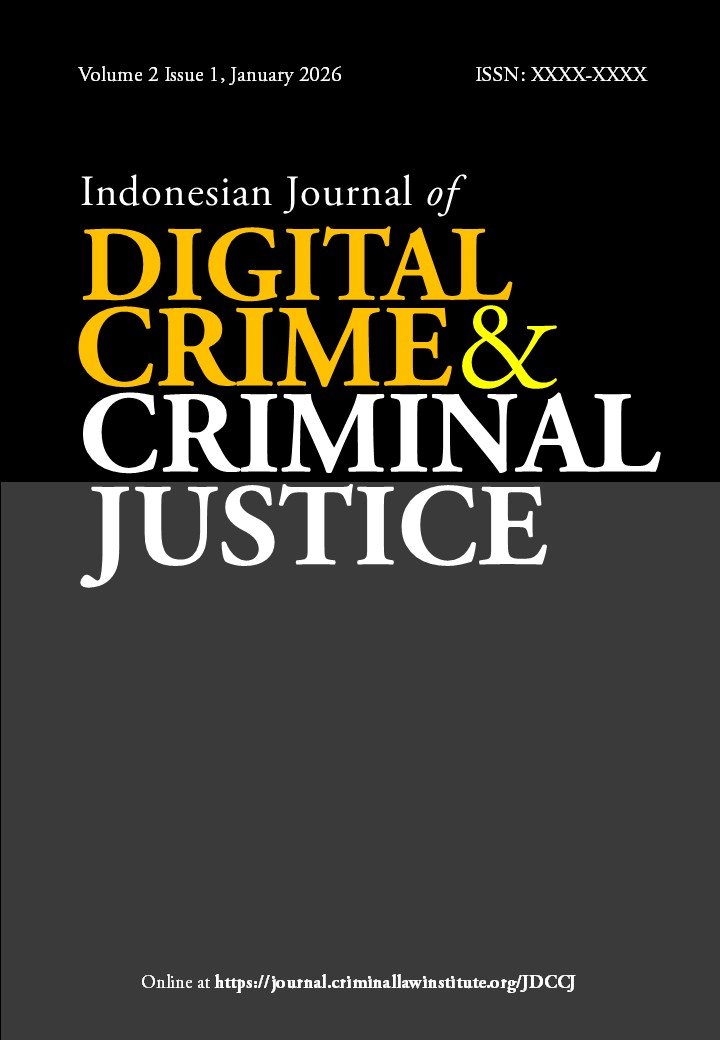
ISSN: 3163-8368 (Print) / 3164-0567 (Online)
Publisher: ILMUWAN HUKUM PIDANA
Division: Criminal Law Institute Division
Acceptance Rate: 40% of the total submissions
Citation Analysis: Google Scholar, Scopus Citedness, Crossref
Frequency: Biannually (January & July)
Title Indexing: On Process
Copyrights: © Author(s) under CC BY 4.0
Published:
2026-01-15
Original Research Articles
The Indonesian Journal of Digital Crime and Criminal Justice is committed to providing immediate and unrestricted open access to all published content, recognizing that free access to scholarly research promotes the global exchange of knowledge and enhances the impact of academic work in the fields of digital crime, cyber law, criminology, and criminal justice. All articles are published under the Creative Commons Attribution 4.0 International License (CC BY 4.0), which permits anyone to read, download, copy, distribute, reproduce, adapt, and build upon the work for any purpose, including commercial use, provided that appropriate credit is given to the original author(s). Authors retain full copyright of their work without any restriction and grant the journal the right of first publication only. Authors are encouraged to deposit and share all versions of their manuscripts, including preprints, accepted manuscripts, and published articles, in institutional repositories, subject repositories, personal websites, and other scholarly platforms without embargo. To ensure the long-term accessibility and integrity of published content, the journal supports digital preservation through its online publishing system and archiving mechanisms, maintaining permanent access to all published articles and safeguarding them against loss, technological obsolescence, or unauthorized alteration.